
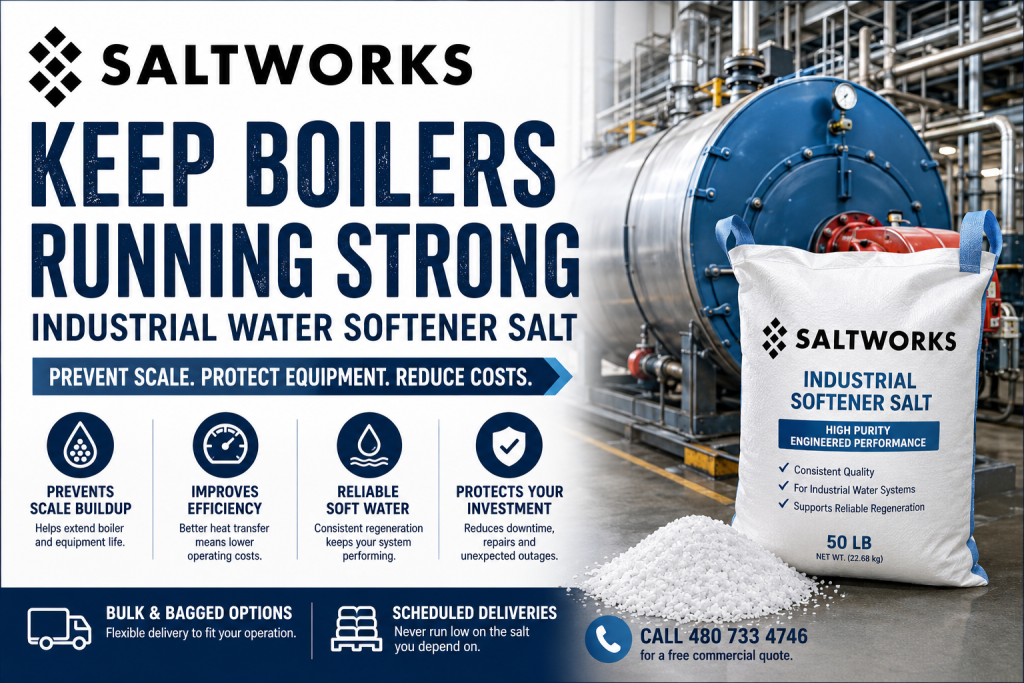
Why Industrial Water Softener Salt Matters for Arizona Boilers
Boilers and heated process equipment are unforgiving places for hard water. Calcium and magnesium that pass through untreated water can form deposits on hot metal surfaces, restricting heat transfer and increasing the chance of maintenance problems. In an Arizona plant, hotel, hospital, laundry or large commercial building, dependable water softening can be an important part of equipment protection.
The softener itself cannot do that work indefinitely without regeneration. It needs the correct industrial water softener salt, a working brine system and a supply plan based on actual water demand.
Boiler Scale Acts Like Insulation
Heat must travel through metal surfaces before it reaches the water inside a boiler. Scale creates an unwanted barrier between the flame or heating source and the water.
The United States Department of Energy notes that calcium, magnesium and silica can form hard scale inside boiler tubes. As deposits grow, heat transfer falls and tube metal may run hotter than intended. Severe buildup can contribute to overheating and tube failure.
Scale is not removed simply by raising the boiler temperature or adding more fuel. The better approach is to manage the incoming water and follow the treatment program established for the system.
Water Softeners Remove Hardness Before Heating
A commercial ion exchange softener captures calcium and magnesium before treated water reaches the boiler or other equipment. Sodium on the resin beads is exchanged for the hardness minerals. When the resin reaches its working capacity, brine regenerates it so the process can continue.
Salt is not being poured into the boiler. It is used in the separate regeneration process. That distinction matters because facility staff sometimes view salt as a minor consumable rather than part of the pretreatment system.
A brine tank that runs empty can allow hardness leakage after the resin can no longer perform properly. The first obvious sign may be a failed hardness test, increased blowdown, scale found during inspection or a decline in equipment performance.
Salt Use Should Follow Water Demand
There is no single monthly salt quantity that suits every industrial softener. Consumption depends on incoming hardness, resin capacity, regeneration settings, water volume and the amount of condensate returned to the system.
Production changes also matter. A facility adding a shift, increasing occupancy or restarting seasonal equipment may use more makeup water than it did when the delivery schedule was created.
Track water meter readings, regeneration cycles and salt additions. If use changes suddenly, investigate rather than assuming the new pattern is normal. Excessive consumption can indicate poor settings, a leaking valve or inefficient regeneration. Very low consumption may mean the unit is not drawing brine.
Protect the Brine System
Industrial salt must remain dry before use and accessible when a delivery arrives. Bagged material should be stored off the floor in a protected area. Bulk tanks and brine systems should be inspected for moisture entry, bridging, blocked lines and damaged covers.
Staff should not climb into tanks or improvise repairs around large commercial equipment. A qualified water treatment professional should address unsafe access, repeated bridging or suspected valve and injector problems.
The correct salt form also depends on the system. Coarse crystals, pellets and bulk products do not handle or dissolve in exactly the same way. Equipment guidance and facility conditions should determine the selection.
Coordinate Salt With the Treatment Program
Water softening is only one part of boiler water management. Chemical treatment, deaeration, blowdown control, condensate return and routine testing may all be required. Cooling towers and specialized process systems can have different chemistry needs, so no salt supplier should replace the facility’s water treatment specialist.
What a reliable supplier can do is keep the specified salt available and deliver it in a way that works with the site.
Schedule Industrial Water Softener Salt Delivery
Salt Works USA provides bulk industrial salt, bagged water softener salt and full service delivery for Arizona commercial facilities. The Mesa based team can help coordinate product quantity, tank access and scheduled supply so a preventable salt shortage does not interrupt the pretreatment system. Call 480 733 4746 today for a free quote on industrial water softener salt delivery.
References
Salt Works USA Bulk Salt Services
Salt Works USA Full Service Salt Delivery
United States Department of Energy Energy Efficiency Handbook
United States Department of Energy Boiler Heat Transfer Guidance